Understanding the Evolution and Impact of AI in Content Creation
In recent years, the digital landscape has experienced a seismic shift, driven largely by the rapid advancement of Artificial Intelligence (AI). At the forefront of this revolution is AI-generated content, a technology that has completely redefined how businesses, marketers, and creators approach digital communication. From drafting compelling blog posts to generating intricate lines of code, AI tools powered by Large Language Models (LLMs) are no longer just experimental novelties; they are essential instruments in the modern marketer's toolkit.
To truly grasp the magnitude of this shift, we must look at how Natural Language Processing (NLP) has evolved. Early iterations of AI writing tools were clunky, producing robotic, keyword-stuffed text that lacked nuance and readability. Today, models like OpenAI's GPT-4, Google's Gemini, and Anthropic's Claude are capable of understanding context, tone, and intent with astonishing accuracy. This leap in capability means that AI can now assist in producing high-quality, engaging content that resonates with human readers.
However, the integration of AI into content strategy is not without its complexities, particularly concerning Search Engine Optimization (SEO). Google and other major search engines have continually updated their algorithms to prioritize Helpful, Reliable, and People-First Content. This means that simply churning out thousands of AI-generated articles will not guarantee top rankings. Instead, success requires a strategic, nuanced approach.
- Enhanced Ideation: AI excels at overcoming writer's block by generating outlines, brainstorming topics, and suggesting unique angles.
- Scalability: Businesses can scale their content production exponentially, translating materials into multiple languages and adapting formats for various platforms.
- Personalization: AI algorithms can analyze user data to tailor content to specific audience segments, increasing engagement and conversion rates.
As we navigate this new era, it is crucial to understand that AI is a co-pilot, not an autopilot. The most successful content strategies leverage the speed and scale of AI while relying on human creativity for empathy, storytelling, and strategic direction.
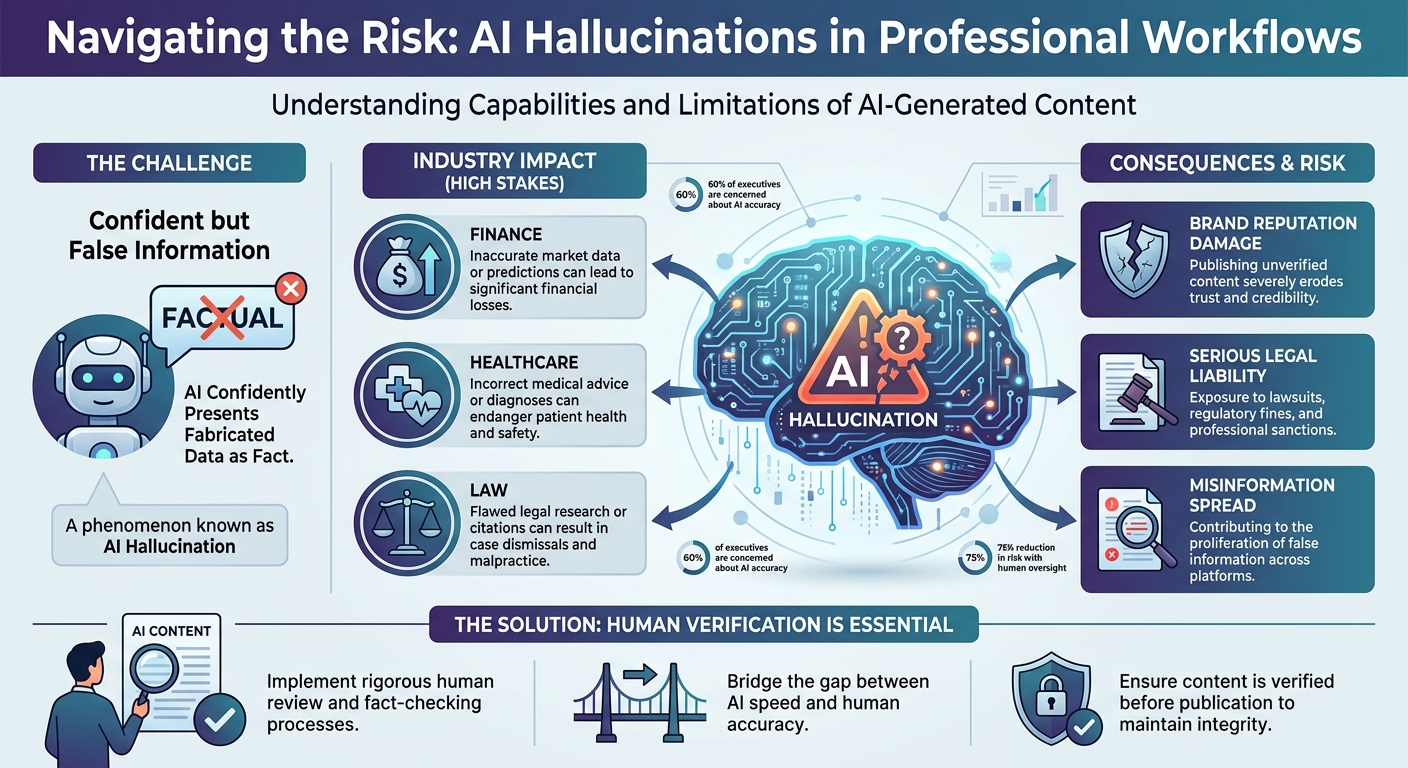
Implementing AI-generated content into your workflow requires a deep understanding of both its capabilities and its limitations. One of the most significant challenges organizations face is the phenomenon known as AI hallucinations—instances where the AI confidently presents false or fabricated information as fact. In industries where accuracy is paramount, such as finance, healthcare, and law, publishing unverified AI content can severely damage a brand's reputation and lead to serious legal repercussions.
To mitigate these risks, industry leaders advocate for the Human-in-the-Loop (HITL) methodology. This approach ensures that human oversight is integrated at every critical stage of the content creation process. Here is how a robust HITL workflow operates:
- Strategic Prompting: Human experts design detailed, context-rich prompts that guide the AI to produce relevant and brand-aligned drafts.
- Fact-Checking and Verification: Every statistic, quote, and claim generated by the AI is rigorously cross-referenced against authoritative sources.
- Stylistic Editing: Human editors refine the AI's output, injecting brand voice, emotional resonance, and cultural nuances that machines often miss.
- SEO Optimization: While AI can naturally integrate keywords, human SEO specialists ensure the content satisfies search intent and adheres to the latest algorithmic guidelines.
Beyond risk mitigation, the HITL approach elevates the quality of the content. Search engines are increasingly adept at identifying low-effort, mass-produced text. By infusing AI-generated drafts with unique human insights, original research, and firsthand experience, creators can produce "10x content" that stands out in a crowded digital ecosystem. Remember, the goal is not merely to produce more content, but to produce better content more efficiently.
Furthermore, businesses must remain transparent about their use of AI. Establishing clear ethical guidelines and editorial standards builds trust with your audience. As you explore the possibilities of automated content solutions, always prioritize the reader's experience. Content that genuinely solves problems, answers questions, and entertains will always win, regardless of whether a human or a machine typed the first draft.
| AI Content Tool | Primary Use Case | Key Strengths | Typical Pricing Model |
|---|---|---|---|
| ChatGPT (OpenAI) | General Writing & Ideation | Versatility, advanced reasoning, conversational context | Freemium / Monthly Subscription |
| Jasper AI | Marketing & Copywriting | Brand voice customization, marketing templates, SEO integration | Tiered Monthly Subscription |
| Claude (Anthropic) | Long-form Content & Analysis | Large context window, nuanced tone, reduced hallucinations | Freemium / Monthly Subscription |
| Copy.ai | Social Media & Short Copy | Speed, ease of use, brainstorming workflows | Freemium / Monthly Subscription |
Future Trends: How AI Will Shape the Next Decade of Content
As we look to the future, the trajectory of AI-generated content points toward unprecedented innovation. We are rapidly moving beyond text-based generation into the realm of multimodal AI. Future models will seamlessly integrate text, audio, image, and video generation, allowing creators to produce comprehensive, interactive multimedia experiences from a single prompt. Imagine an AI that not only writes a blog post but also generates an accompanying podcast episode, custom infographics, and social media video snippets simultaneously.
Hyper-personalization will also reach new heights. AI will enable dynamic content that adapts in real-time to the reader's preferences, reading level, and current context. A single article could present itself as a high-level summary for a busy executive, or a deep-dive technical manual for an engineer, all generated on the fly. This level of personalization will dramatically improve user engagement and redefine the metrics by which we measure content success.
However, this rapid advancement will inevitably bring new regulatory and ethical challenges. Issues surrounding copyright infringement, data privacy, and the ethical use of training data will dominate industry discussions. Organizations that proactively adopt ethical AI frameworks and prioritize transparency will be best positioned to navigate this complex landscape safely.
Ultimately, the organizations that thrive in the AI era will be those that view AI as an amplifier of human potential, rather than a replacement for it. By embracing these tools thoughtfully, we can unlock new levels of creativity and forge deeper connections with our audiences.
For media inquiries, please contact our team:
Name: NA NA
Email: NA
Phone: NA
Address: NA
Q1: Will Google penalize my website for using AI-generated content?
No, Google does not strictly penalize content simply because it is AI-generated. Google's focus is on the quality of the content. If the AI-generated content is helpful, high-quality, original, and satisfies user intent (E-E-A-T principles), it can rank well. However, spammy, low-value AI content will be penalized.
Q2: Can AI completely replace human writers?
While AI is incredibly powerful at generating text quickly, it lacks true human empathy, lived experience, and original thought. AI is best utilized as an assistant to handle heavy lifting, outlining, and drafting, while human writers are essential for strategy, editing, voice, and injecting unique insights.
Q3: How do I prevent AI from generating false information?
AI models can 'hallucinate' or state false facts confidently. To prevent this, always use a Human-in-the-Loop (HITL) approach. Fact-check all statistics, names, and claims against reliable sources, and use specific, highly detailed prompts to guide the AI's output accurately.
Q4: What is the best AI tool for SEO content writing?
There is no single 'best' tool, as it depends on your workflow. ChatGPT and Claude are excellent for general drafting and complex reasoning. Jasper and SurferSEO are popular for specific marketing and SEO integrations, as they offer built-in optimization features and brand voice alignment.
Q5: Who owns the copyright to AI-generated content?
Copyright law regarding AI is still evolving. Currently, in many jurisdictions like the US, content generated entirely by a machine without significant human creative input cannot be copyrighted. However, if a human heavily edits, curates, and transforms the AI output, they may claim copyright over the final published work.
Transform Your Content Strategy Today